The Ancient Silk Heritage of North East India is Vanishing. You can Save It.

We empower indigenous communities to fight climate change through the Integral Model. Join this climate resilience movement today.

For 47-year-old Bina Devi, silk is not just fabric. It's her ancestors' heritage and her children's future.

You see, for many millennia, people in North East India have been engaged with sericulture. Everything was going well and smooth, until climate change knocked at its doors.

Increasing pollution, pesticides used in tea gardens & beyond, combined with the impacts of climate change brought great dangers to the rearing of silk in the region. It is getting more and more difficult to rear the silk now. And with this, it poses a threat to the livelihoods of thousands of people from indigenous communities.

Read Bina's Full Story
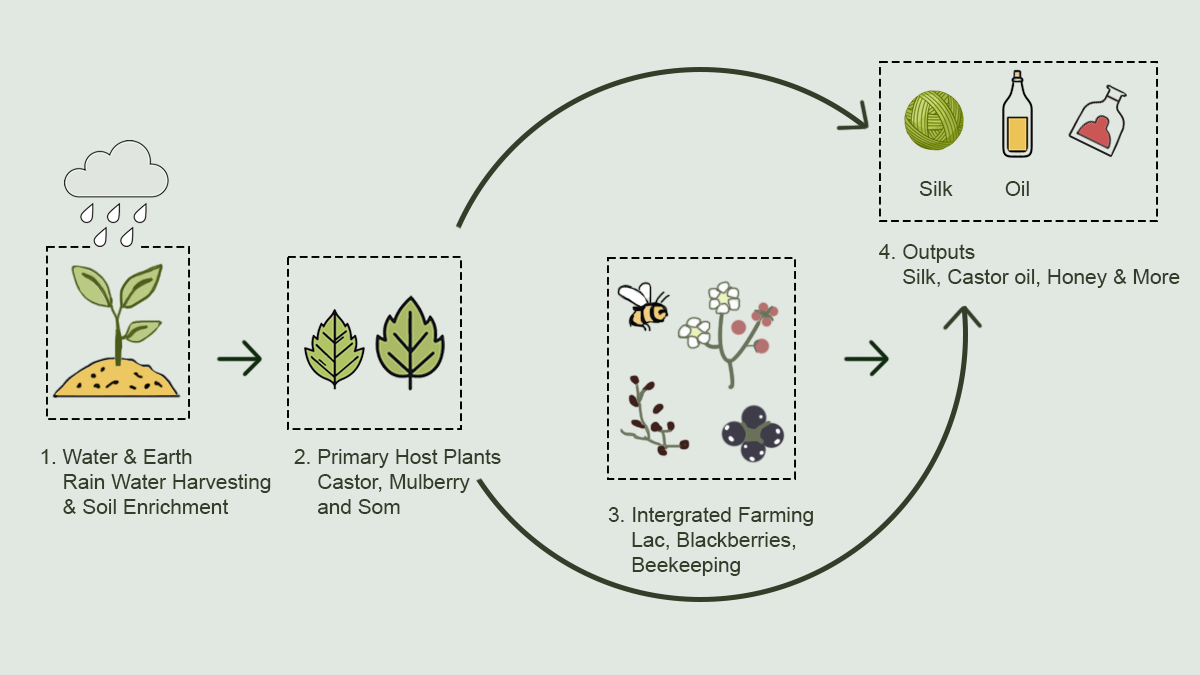
The Integral Model: Ecology is Economy

Years of experimentation and tinkering with systems on the ground led us to develop the Integral Model. It firmly stands on three pillars: Natural Farming, Sri Aurobindo's Integral Yoga and the ancient Indian concept of Vinyasa.

Here, every activity is an enabler for the next one. We harvest the rain to enrich the soil; we enrich the soil to feed the silk; we use the silk to create a bio-economy of oil, honey, blackberries and heritage crafts.

The Integral Model: Vinyasa of the Bio-Economy
Learn More About The Integral Model

What We Do

Stage 1: Foundation

Climate Resilience

We secure the environment so the economy has a stable base.

Stage 2: Engine

Regenerative Agriculture

We restore the land to power the bio-economic cycle.

Stage 3: Output

Heritage Craft & Livelihoods

We transform biological health into artisanal wealth.

Stage 4: Market

Community Sovereignty

We ensure wealth stays in the hands of the indigenous knowledge holders.

Beyond Silk

The Economic Multipliers of a Healthy Ecosystem

The Integral Model creates diversified, resilient livelihoods. Our artisan families produce multiple products from integrated farming systems—each supporting the others.

Ahimsa Silk

Peace silk, cruelty-free

Mulberry Silk

Classic, lustrous fiber

Muga Silk

Golden silk of Assam

Castor Oil

Cold-pressed organic

Honey

Wild forest honey

Lac Powder

Natural resin for dyes

This diversity means families aren't dependent on a single crop, season or market. When one product faces challenges, others sustain income. This is climate resilience in action.

Our 80/20 Impact Framework

At Integral, we reject the idea that nonprofits should be ‘low cost’ at the expense of being ‘low impact'. Instead, we believe solving complex problems in the North East requires being as strategic as we are passionate.

That's why we operate on a disciplined 80/20 Framework.

80%

Direct Impact

At least 80% of every Rupee goes directly to our programs on the field—buying raw materials, setting up community hubs, and training our artisans.

20%

Operational Excellence

We invest 20% into the 'engine'—the experts, the logistics, the technology and fundraising efforts that ensure our impact is long-lasting, sustainable, and measurable rather than a temporary fix.

This isn't overhead. It's infrastructure for impact.

From Farm to World

Local Markets

Regional buyers and community procurement provide immediate, reliable income—sustaining traditional supply chains across North East India.

Global Reach via Gaongiri

Through Gaongiri, our flagship online store, we connect artisans directly with conscious consumers worldwide—eliminating exploitative middlemen.

80% of every Gaongiri sale goes directly to the farmer or the artisan

Working Together for Impact

Assam Agricultural University

Technical expertise in climate-resilient sericulture and sustainable agriculture practices across North East India

Balipara Foundation

Landscape-level conservation and community development, working with indigenous communities for biodiversity and livelihoods