Ecology is Economy
Every activity is an enabler for the next one. We harvest the rain to enrich the soil; we enrich the soil to feed the silk; we use the silk to create a bio-economy of oil, honey, blackberries and heritage crafts.
Three Pillars of the Model
The Integral Model stands firmly on three foundational philosophies.
Natural Farming
Working with nature's rhythms rather than against them—building soil health, biodiversity, and climate resilience through organic, regenerative practices rooted in traditional knowledge.
Sri Aurobindo's Integral Yoga
Development must address both material conditions and inner consciousness. We integrate Sri Aurobindo's philosophy of consciousness evolution with practical interventions in agriculture, craft preservation, and climate adaptation.
The Ancient Indian Concept of Vinyasa
The deliberate sequencing of activities to create harmonious flow. Every activity becomes an enabler for the next—we harvest rain to enrich soil, enrich soil to feed silk, and use silk to create a complete bio-economy.
The Vinyasa of Value Creation
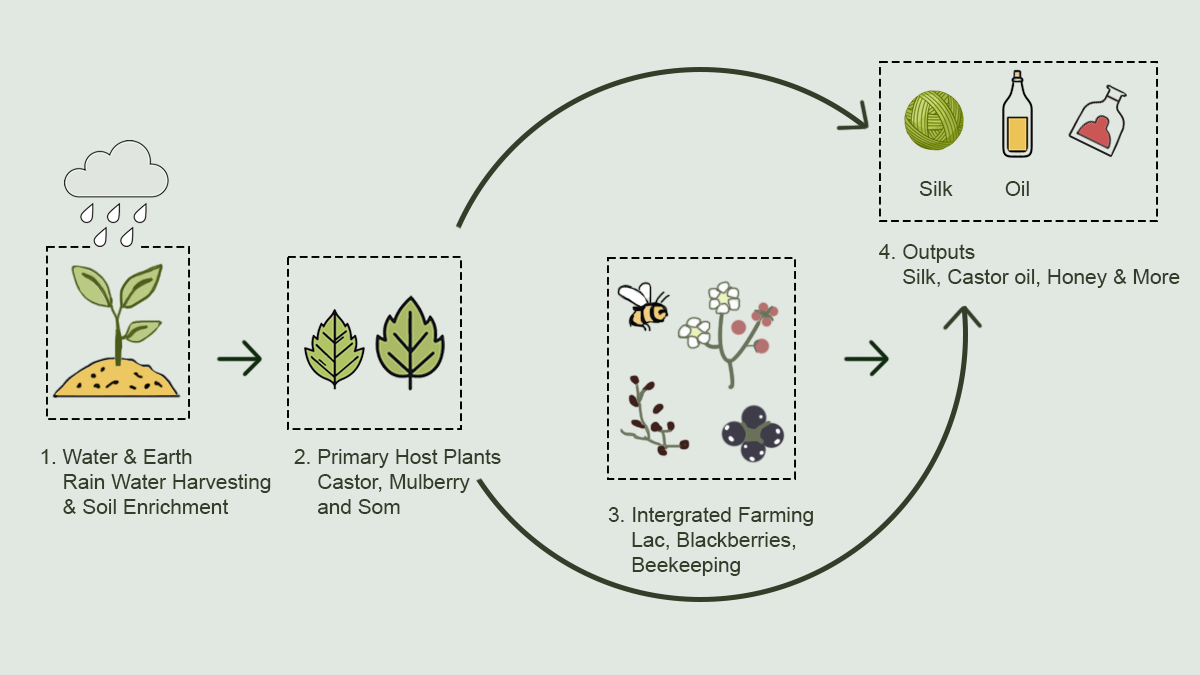
Water & Earth (The Foundation)
We begin with Rainwater Harvesting to ensure year-round resilience and Soil Enrichment to prepare the bio-engine.
The Bio-Engine (Primary Host Plants)
We plant Castor, Mulberry, and Som trees—the specific nutrients required for Eri, Mulberry, and Muga silkworms.
The Multipliers (Integrated Farming)
We layer in Beekeeping, Lac, and Blackberries. These species work in synergy to boost pollination and diversify village income.
The Marketplace (Outputs)
The result is a zero-waste harvest of Ahimsa Silk, Mulberry Silk, Muga Silk, Castor Oil, Forest Honey, Lac Powder, and Blackberries.
One Ecosystem, Multiple Impacts
We cultivate the primary food plants for the three legendary silks of North East India. While these plants sustain the silkworms, they simultaneously create a diverse marketplace of byproducts.
Detailed Activity Breakdown
Explore the sequential stages of the Integral Model.
Rainwater Harvesting
We implement community-managed catchment systems to capture monsoon runoff, providing the essential water security needed for year-round silk cycles.
Soil Enrichment
Instead of chemical fertilizers, we use organic soil regeneration techniques and indigenous bio-inputs to create a nutrient-dense foundation for our host plants.
Castor (Ricinus communis)
Planted primarily as the food source for Eri silkworms; the seeds are later harvested for high-quality organic oil.
Mulberry (Morus alba)
Cultivated using organic methods to feed the Bombyx mori worms, with the added benefit of producing nutrient-dense berries.
Som Trees (Persea bombycina)
These indigenous trees serve as the outdoor "rearing rooms" for Muga silkworms, doubling as vital carbon sinks for the region.
Beekeeping
We introduce scientific beekeeping to boost the local pollination rate, which naturally increases the health of our silk host plants.
Lac Cultivation
By layering Kerria lacca insects into the canopy, we harvest natural resin used for traditional dyes and industrial applications without harming the trees.
Blackberries
Planted as protective bio-fences, these provide a secondary food source for the community and additional forage for the bees.
Spinning
We promote hand-spinning of raw silk into high-texture yarns, ensuring the fiber retains its natural, thermal-regulating properties.
Weaving
Our master artisans use traditional floor looms to transform the silk into exquisite products, preserving motifs that represent the heritage of North East India.
Why This Works
Every activity serves a dual purpose — ecological restoration and economic empowerment.
Four Pillars of Practice
Our model translates philosophy into action through four interconnected pillars, each addressing a dimension of sustainable livelihoods.
Sustainable Agriculture
Climate-resilient sericulture that works with nature's rhythms, not against them.
- Organic mulberry cultivation techniques
- Indigenous silkworm rearing methods
- Soil regeneration and biodiversity protection
- Water conservation systems
- Adaptation strategies for climate variability
Craft Preservation
Reviving traditional silk weaving as a dignified livelihood and cultural heritage.
- Master artisan mentorship programs
- Documentation of traditional patterns
- Fair-trade market connections
- Skills training for next generation
- Design innovation rooted in tradition
Climate Resilience
Building adaptive capacity to thrive amid climate uncertainty.
- Climate-smart agriculture training
- Indigenous weather forecasting knowledge
- Disaster preparedness systems
- Crop diversification strategies
- Community-based early warning networks
Community Development
Empowering indigenous communities with resources, education, and self-determination.
- Women's self-help groups formation
- Financial literacy and savings programs
- Youth leadership development
- Traditional knowledge systems integration
- Community-led decision making
Financial Integrity
Transparency is the bedrock of our movement.
At the Integral Foundation, we believe that transparency is the bedrock of any movement. Unlike traditional top-down development, our model is designed to maximize the flow of resources directly to the indigenous artisans of North East India.
Where Your Support Goes
We guarantee that 80% of all resources are invested directly back into the village ecosystems.
The Integral Starter Kits
Funding the initial Rainwater Harvesting infrastructure and the procurement of indigenous seeds and silkworm eggs.
Technical Training
Providing master-led workshops on Soil Enrichment, Beekeeping, and advanced "Ahimsa" silk rearing.
Artisan Processing Hubs
Setting up village-level centers for silk spinning, weaving, and the extraction of Castor Oil and Honey.
Community Managed Funds
Empowering local self-help groups to manage their own savings and development priorities.
The Role of Gaongiri: The Digital Bridge
To protect this 80% return, we built Gaongiri. By creating a direct digital link between the village and the conscious consumer, we eliminate exploitative middle-layers and "hidden costs" that traditionally drain rural wealth. Every product purchased through Gaongiri validates the Integral Model, turning a marketplace transaction into a revolutionary act of support.
Visit Gaongiri Store →What makes the Integral Model different
Traditional Development
- Single-issue focus (poverty OR environment)
- External experts design solutions
- Technology transfer without cultural context
- Short-term projects with exit strategies
- Economic metrics as primary success measure
- Communities as beneficiaries
Integral Approach
- Addresses interconnected systems holistically
- Communities lead, we support
- Honors indigenous knowledge + modern science
- Long-term partnership for sustained transformation
- Wellbeing across all dimensions of life
- Communities as co-creators and knowledge holders
Impact Stories
Real transformations from the field.
Lakshmi's Vinyasa: From One Crop to Five Streams of Income
The Challenge
Lakshmi Devi used to rely solely on seasonal silk farming. If the monsoon was late or the market price dipped, the family faced months of debt. With no backup income, one bad season meant borrowing at high interest rates just to survive.
The Integral Difference
With our support, they first built rainwater harvesting tanks, ensuring their land stayed fertile during the dry season.
They replaced depleted land with Castor and Mulberry plantations, creating a sustainable food source for silkworms.
They layered in Beekeeping and Lac cultivation, transforming their silk farm into a thriving, interconnected ecosystem.
The Result
Lakshmi now manages five distinct revenue streams: Silk, Castor Oil, Forest Honey, Lac Powder, and Blackberries. Because of our 80% direct-to-artisan model, she earned 40% more this year than under traditional systems.
Read more stories →"I no longer fear the weather. When the rain is late, I have the honey. When the silk market is slow, I have the oil. My land finally works as one."
— Lakshmi Devi, Majuli
Support the Integral Model
Your contribution funds holistic transformation that honors tradition, restores nature, and builds dignified livelihoods across generations.